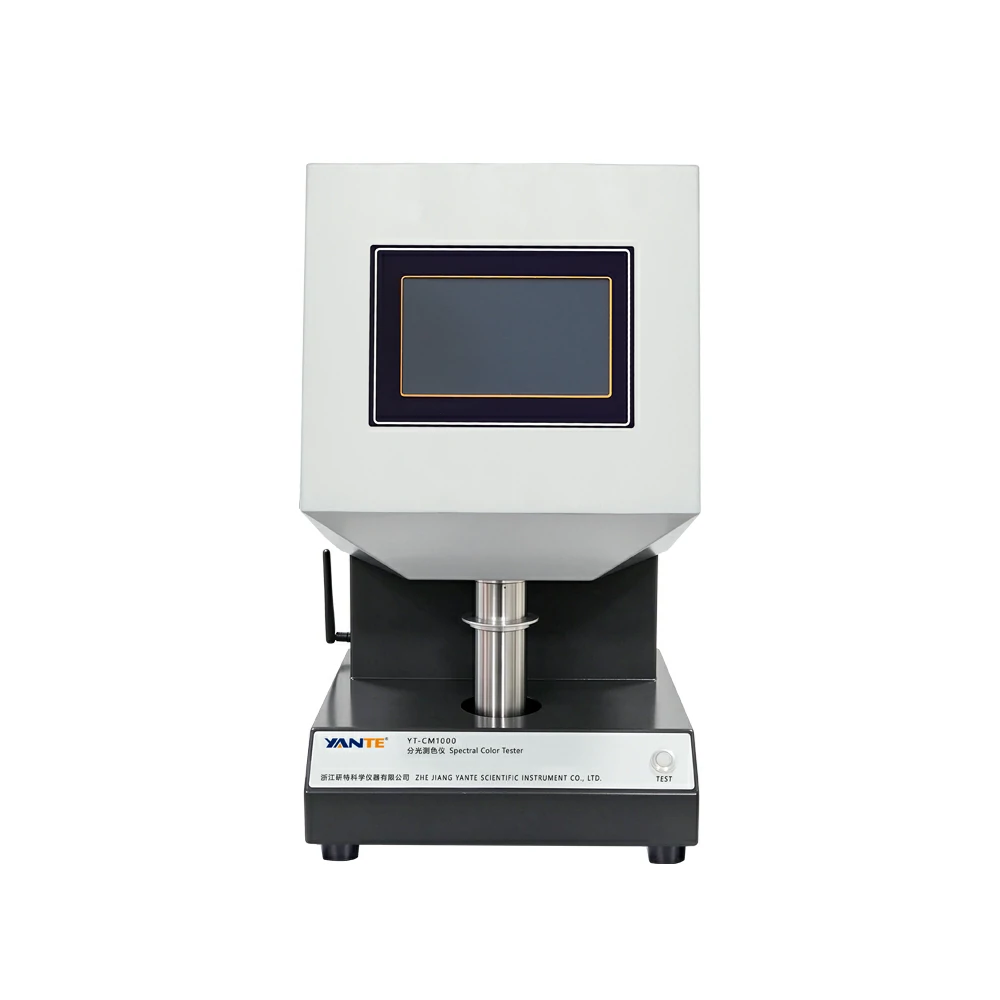
The Spectral Color Tester is a precision instrument for measuring the whiteness, color and color difference of solids. It is widely used in papermaking, printing, textile dyeing and printing, ceramics, building materials, chemicals, grain and salt production, as well as in production and commodity inspection departments that require measurement of the color and whiteness of solids.

Papermaking, printing, textile dyeing and printing, ceramics, building materials, chemicals, grain and salt production, as well as production and commodity inspection departments that require measurement of the color and whiteness of solids.

● Measure the color and color difference of solids under C and D65 illuminants:
● Tristimulus values and chromaticity coordinates in the CIE 1931 standard colorimetric system;
● Tristimulus values and chromaticity coordinates in the CIE 1964 supplementary standard colorimetric system;
● L*, u*, v*, C*uv, Suv, huv, a*, b*, C*ab, hab and color difference in the CIE 1976 uniform color space.
● Determine CIE whiteness (Ganz visual whiteness) W10 and tint value Tw10
● Measure the D65 brightness of the blue-light diffuse reflectance factor and the fluorescence brightness of fluorescent whitening materials.
● Measure ISO brightness under indoor illuminant C/2° conditions and the fluorescence brightness of fluorescent whitening materials.
● Determine the whiteness and color of building materials, non-metallic mineral products and ceramics.
● Determine whiteness, Lab values and color difference in the Hunter system.
● Determine the whiteness and chromaticity of fibers (with the matching fiber sampler).
● Measure the whiteness, chromaticity, Lab values and color difference of powders.
● Determine yellowness YI, opacity OP, light scattering coefficient S, light absorption coefficient A, transparency and ink absorption value.
● Measure the reflection densities Dx, Dy and Dz.

● Cotex-M4 ARM Processor
● Imported concave flat-field grating, photodiode array sensor, pulsed xenon lamp and other components lay the foundation for the instrument's accuracy.
● A stepper motor controls and automatically adjusts the UV radiation dose precisely, enabling one-key measurement of fluorescence brightness.
● Test data can be exported via a USB flash drive.
● Both the system and screen software support upgrades via network or USB flash drive.
● Automatic aperture recognition: the instrument is equipped with two measurement apertures, Φ18mm and Φ34mm; custom apertures are available to meet special measurement requirements.
● The instrument comes standard with a touch screen and offers two operation modes: touch screen operation and PC software operation, allowing users to choose freely. Touch screen operation is fast and convenient; with PC software operation, test data storage is unlimited, historical measurement data can be easily reviewed and printed, and the number of standard samples is unlimited.
● Multiple communication methods are supported; the PC software communicates via Wi-Fi or USB.
● Test data can be uploaded to a cloud server and, together with the QMS paper quality management system (optional), enables real-time monitoring of paper testing data.

GB/T 7974-2013,GB/T 10339-2018,GB/T 7973-2003,GB/T 7975-2005,GB/T 3979-2008 ,GB/T 9338-2008,GB/T 2679.1-2020,GB/T 1543-2005,GB/T 10339-2007,GB/T 8940.2,GB/T 5950,ISO 2469,ISO 2470-1,ISO 2470-2,ISO 2471,ISO 9416,ISO 11475

NO. | Parameter items | Technical Indicators |
1 | Power Supply | AC (100-240) V, (50/60) Hz, 50 W |
2 | Operating Environment | Temperature (10~35) °C, relative humidity ≤85% |
3 | Display | 7-inch IPS HD screen, 1024*600 resolution, capacitive touch |
4 | Geometry | Dual-beam (d/0) |
5 | Light Source | Pulsed xenon lamp, calibrated with D65 and C illuminants |
6 | Measurement Area / Test Aperture | Φ28mm/Φ34mm, Φ16mm/Φ18mm |
7 | Photometric Linearity Error | 0.5% |
8 | Bandwidth | 14nm |
9 | Detector | Dual-row 32-element photodiode array |
10 | Wavelength Range | 400~700 nm |
11 | Measurement Range | 0-200% |
12 | Measurement Time (Typical) | 4~20 s |
13 | Repeatability | ≤0.05 CIELAB (ΔE*) |
14 | Reproducibility (Inter-instrument Difference) | ≤0.50 CIELAB (ΔE*) |
15 | Observer Angle | 2°,10° |
16 | Data Interval | 10nm |
17 | UV Cut-off Filters | 395, 420nm |
18 | Communication Interface | USB2.0, Wi-Fi (2.4G) |
19 | Dimensions | 320*290*540mm |
20 | Net Weight | Approx. 18.3kg |





 33011002013339号
